
Competitive Intelligence
Definition, challenges and implementation
Competitive intelligence refers to an organization's ability to collectively transform information into a competitive advantage. Long perceived as a discipline reserved for large corporations, it is a lever for competitiveness accessible to any organization that knows how to structure itself around strategic monitoring, analysis, and information sharing. This page aims to help you understand its foundations, its roles, its tools, and the concrete steps to implement it.
- Competitive Intelligence Definition, challenges and implementation
- What is competitive intelligence?
- Intelligence professions in business
- Economic intelligence,A collective affair
- Economic intelligenceis not just for large groups
- Competitive intelligence at the service of economic intelligence
- The tools of economic intelligence
- The necessary transformation Digital Intelligence
- How to set up An economic intelligence approach?
- The Curebot approach: collaborative, accessible and sovereign economic intelligence
- To go further
What is competitive intelligence?
Definition and origins
Competitive intelligence refers to all coordinated actions involved in researching, processing, disseminating, and protecting information useful for an organization's strategic decisions. Formalized in France by the Martre report in 1994, this discipline goes far beyond simply collecting information. It aims to transform raw information into a sustainable competitive advantage by engaging all of an organization's stakeholders.
The three pillars of economic intelligence
Pillar 1
market intelligence
Systematic environmental monitoring to detect, process, analyze and disseminate relevant information to the right people.
Pillar 2
Information Protection
Sécurisation du patrimoine informationnel et immatériel de l’organisation contre les risques de fuite, d'intrusion ou de déstabilisation.
Pillar 3
Influence
Lobbying, economic diplomacy and outreach that allow the organization to influence its environment.
What is the difference between competitive intelligence and market intelligence?
Strategic monitoring constitutes the first pillar of competitive intelligence, but it represents only one component. It focuses on the systematic monitoring of the environment, the collection, processing, and dissemination of relevant information. Competitive intelligence encompasses this monitoring dimension, but adds to it the protection of information assets and influence operations.
Strategic monitoring feeds economic intelligence with information; economic intelligence orchestrates its exploitation in service of the organization's overall strategy.
In practice, the two concepts are inseparable: an economic intelligence approach without structured monitoring lacks raw material; monitoring without an economic intelligence vision risks producing information without decision-making impact.
Intelligence professions in business
Complementary specialist profiles
Intelligence professions encompass all employees who handle strategic and operational information on a daily basis, transforming it into actionable knowledge and making it available to the organization. From the knowledge manager who structures knowledge to the competitive intelligence analyst who feeds the sales teams, including the information specialist, the competitive intelligence analyst, the market intelligence analyst, the foresight analyst and the economic intelligence manager, these profiles are structured around the complete information management cycle and constitute the informational nervous system of the company.
Intelligence at the heart of all business lines
Beyond these specialized profiles, all organizational functions inherently require information to carry out their activities and develop their expertise. Analysis of job descriptions in companies confirms this: activities related to intelligence production—synthesis, benchmarking, monitoring, research, and strategic decision-making preparation—are common across all job families.
Chaque collaborateur assume donc, à son niveau, une double responsabilité : développer une connaissance spécifique à son domaine d’activité et contribuer au rayonnement de son expertise au sein de l’organisation. Cette réalité implique un double enjeu d’autonomisation et de responsabilisation de chaque salarié dans le cycle de gestion de l’information.
Economic intelligence,
A collective affair
Organizational models for monitoring
The way an organization structures its competitive intelligence and intelligence activities directly determines its ability to deliver the right information to the right people.
| Model | Principle | Feature |
|---|---|---|
| Handcrafted | Individual | initiativesWithout coordination or tooling |
| Centralized | Dedicated | teamCentral production and distribution |
| Decentralized | Business autonomy | Can evolve to collaborative |
| Hybrid | Central + Decentralized | Suitable for large structures |
The artisanal model relies on individual initiatives, without coordination or shared tools. The centralized model entrusts intelligence gathering to a dedicated team that produces and disseminates information for the entire organization. The decentralized model empowers departments to conduct their own intelligence activities; when accompanied by dynamics of sharing and pooling between departments, it can evolve into a truly collaborative operation. Finally, the hybrid model combines a centralized component and a decentralized component within the same system.
These models provide a conceptual framework. In reality, each company builds its own system based on its culture, resources, and objectives. Data collection may be decentralized and analysis conducted centrally, or vice versa. The key is that the chosen model serves a clear purpose: to circulate the right information to the right people at the right time.
Multiplying the impact of economic intelligence through the collective
Data, information, and knowledge management is taking on an increasingly strategic dimension: it informs decision-making processes, optimizes business performance, and supports collaborative dynamics among employees. While monitoring and its components—surveillance, collection, processing, analysis, and dissemination—have historically formed the cornerstones of competitive intelligence approaches, sharing, capitalizing on, exchanging, and deliberating around information and knowledge are equally essential for effective competitive intelligence.
The proliferation of redundant platforms and the underutilization of organizational cognitive capital generate considerable costs. Streamlining and pooling intelligence efforts not only reduces these costs but also dramatically increases their informational impact. However, French companies and organizations have fallen behind on these issues. Most competitive intelligence initiatives still involve only a few employees and are often limited to data collection and dissemination in the form of simple newsletters.
Faced with the escalating promises of digital technology and artificial intelligence, it is urgent that organizations develop their collective intelligence if they do not wish to see decision-making, strategy and innovation functions be uberized by purely computational approaches.
Seizing the opportunities of digital technology means bringing together a greater number of stakeholders around these approaches to optimizing and leveraging information. This conviction is precisely what constitutes the raison d'être of EspritsCollaboratifs and the reason for Curebot: to enable organizations to organize themselves around the activities of monitoring, analyzing, and sharing information in order to develop their competitiveness.
Some of our clients have been able to attract dozens, hundreds, or even thousands of contributors and beneficiaries to their monitoring approach.
Economic intelligence
is not just for large groups
At EspritsCollaboratifs, we hear the same comment regularly: “We’re too small to implement a strategic intelligence solution.” Our years of experience working with Curebot clients allow us to assert the opposite. The professionalism of an intelligence approach, the number of people involved, and the associated budget are not necessarily linked to the size of the company.
The real question isn't size, but organizational maturity: does the company understand the links between information management, business performance, and strategic decisions? With the same budget, two organizations can achieve completely different impacts on their performance. Organizational maturity, not size, is the determining factor.
Competitive intelligence at the service
of economic intelligence
Each competitive intelligence activity constitutes an operational building block of the overall competitive intelligence approach. From commercial intelligence that supports business development to regulatory intelligence that anticipates changes in the legal framework, and including innovation intelligence that detects emerging technologies, these specialized activities cover the entire ecosystem of the organization.
The 32 types of monitoring identified are grouped into 8 main categories: business development & marketing, innovation & technology, compliance & regulatory, competitive & strategic environment, risks & security, resources & partnerships, communication & influence, and development & financing.
The potential for sharing information between these monitoring systems is considerable. A single source can feed into several industry-specific monitoring systems, and the same signal can be relevant to different departments. It is precisely this cross-functionality that justifies a collaborative and tool-based approach to strategic intelligence.
The tools of economic intelligence
Market intelligence and competitive intelligence: a frequent confusion
The search for "business intelligence tools" in Google's results refers to two very different universes.
| Competitive Intelligence | Market Intelligence | |
|---|---|---|
| Data | Internal, structured | External, open source |
| Tools | Power BI, Tableau, Looker | Monitoring platforms |
| Question | What is happening internally? | What happens outside? |
| Deliverables | Dashboards, reporting | Analyses, alerts, summaries |
On one hand, there are business intelligence (BI) tools—Power BI, Tableau, Looker Studio—which analyze the company's internal and structured data to produce dashboards and reports. On the other hand, there are competitive intelligence tools in the French sense of the term—strategic monitoring platforms—which monitor the organization's external environment to detect, collect, analyze, and disseminate relevant information from open sources.
These two families of tools are complementary but address fundamentally different needs. Business intelligence (BI) answers the question, "What is happening inside my organization?" Competitive intelligence tools answer the question, "What is happening in my environment that could impact my decisions?" A mature competitive intelligence approach relies on both, but strategic monitoring forms the operational foundation of competitive intelligence.
From free to professional: the different levels of tools
Organizations new to competitive intelligence often rely on free tools: Google alerts, RSS feed readers, and manual social media monitoring. These tools provide initial awareness but quickly reach their limits: lack of comprehensive coverage, no collaborative work, no capitalization of collected information, and no structured analysis.
Switching to a professional strategic intelligence platform allows you to structure the entire information cycle: configuring qualified sources, automating monitoring, categorizing and enriching content, targeted distribution to the right recipients, and building on this information in a shared knowledge base. The key is not so much the volume of monitored sources as the ability to circulate the right information to the right people at the right time.
What distinguishes a collaborative monitoring platform
Beyond traditional monitoring and data collection functionalities, a collaborative intelligence platform stands out for its ability to involve a wide range of contributors and beneficiaries in the process. It allows subject matter experts to contribute directly—by qualifying information, adding their analysis, and sharing their own findings—while offering decision-makers easy access to summaries and key signals through dedicated intelligence portals.
It is this collaborative dimension that transforms the monitoring of an activity by a few specialists into a true lever of collective intelligence at the service of the entire organization.
The necessary transformation
Digital Intelligence
AI at the service of the information cycle
Artificial intelligence now offers concrete applications across the entire information cycle: recommending relevant sources, expanding monitoring capabilities, eliminating language barriers, automatic summarization, extracting key points, categorizing and mapping stakeholders, and even providing conversational interfaces with knowledge bases. These contributions are real and enable significant productivity gains for professionals in competitive intelligence and market intelligence.
Why technology alone is not enough
However, the digital transformation of competitive intelligence is not simply a matter of integrating AI into monitoring tools. The history of digital technologies teaches us that technology alone does not transform organizations.
Imagine a market intelligence platform fully automated by AI: the analysis report is generated, but who reads it? Who passes it on to the management committee? Who makes operational decisions based on it? Organizational dysfunctions — lack of link to decision-making bodies, power games, self-censorship, egos of decision-makers — persist regardless of technological sophistication.
The figures confirm it: it is not the accumulation of additional tools that solves the problem, but the reinvention of the organizational approach.
Transforming practices, not just tools
The real transformation lies in the overall improvement of performance in each profession through better information management. This requires investing in change management support, updating job descriptions, training in information and digital literacy, and implementing organizational models that promote the flow of information. It also means building a trusted information asset that will serve as the reference database for training artificial intelligence.
The companies that succeed are not those that accumulate the most powerful tools, but those that have learned to form alliances with the multitude of individuals connected in a network within their organization.
How to set up
An economic intelligence approach?
Implementing a competitive intelligence approach begins with identifying a sponsor capable of championing the project within decision-making bodies. This support is essential: without leadership at the management level, the approach risks remaining an isolated exercise, disconnected from the organization's strategic objectives.
It is then a question of understanding the pains of the professions. What are the concrete challenges that teams face on a daily basis?
Case 1
Commercial
A sales manager who loses calls for tenders because he did not anticipate the movements of a competitor.
Case 2
Legal
A legal team overwhelmed by regulatory changes that it discovers too late.
Case 3
Innovation
An innovation manager who misses out on an emerging technology adopted by a new entrant.
The next step is to identify the information needs of each role: what information do they need to make better decisions, anticipate, and act? What sources do they already consult, formally or informally? What are the blind spots, the topics they are navigating blindly? This needs mapping helps define the expected benefits of the approach: reduced areas of uncertainty, improved sales conversion rates, proactive regulatory compliance, early detection of weak signals, and better coordination between teams.
On this basis, it becomes possible to audit the existing situation — what monitoring practices are already in place, what tools are used, what skills are available — and then to define realistic objectives, an appropriate scope and the resources to be allocated.
Start with a small scope, focused on one or two pilot businesses, to quickly demonstrate the value of the approach before gradually generalizing it.
The Curebot approach: collaborative, accessible and sovereign economic intelligence
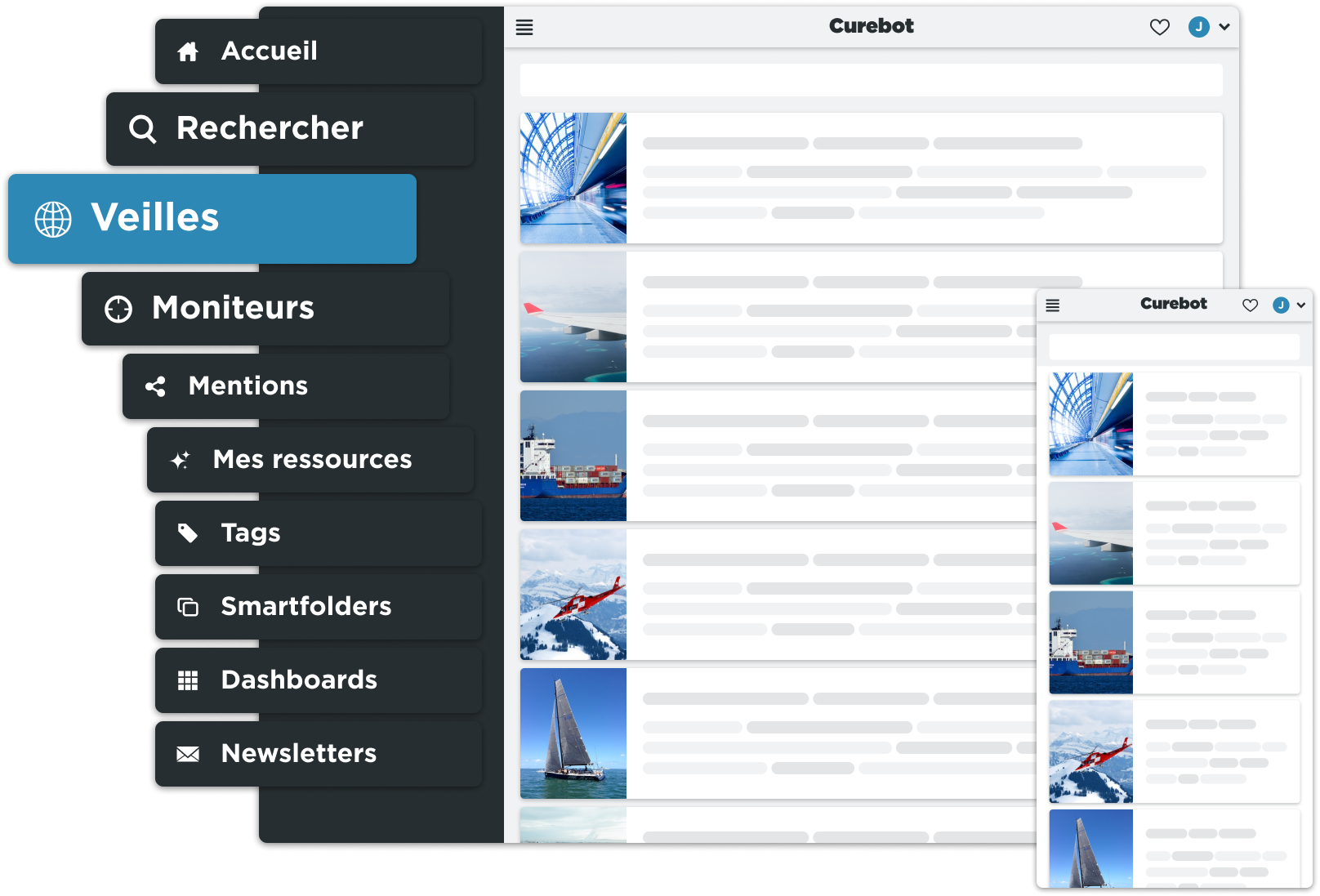
Curebot, the collaborative strategic intelligence platform published by EspritsCollaboratifs, adapts to the size of your intelligence gathering efforts, your stakeholders, and your ambitions. Whether supporting a team of a few intelligence analysts or deploying a collaborative dynamic involving hundreds of contributors, Curebot can support a truly decentralized intelligence practice, regardless of the company's size.
Its redesigned user experience allows for rapid adoption by non-experts in competitive intelligence. Its open-source AI, hosted in France, guarantees data sovereignty and compliance. Its pricing allows for very affordable project start-ups, suitable for both SMEs and large organizations.
EspritsCollaboratifs' integrated offering combines the Curebot platform with comprehensive consulting support: audit of existing practices, definition of the roadmap, implementation of governance, training and support for the empowerment of contributors.