


RTE: Collaboration leads to intelligence
With the Curebot solution from Esprits Collaboratives, RTE (Réseau de Transport d’Electricité) is gradually extending its monitoring.
Responses to the business lines and the valorization of information are obtained through a very collaborative dynamic.
Céline Gombert belongs to the economic development and territories department within the coordination and territorial action division of RTE. This public company of 9,500 people, headquartered in Paris and organized into seven regions, has the mission of guaranteeing the electricity supply of France (it owns the high-voltage infrastructure).
When the Economic Development and Territories Department was created in 2019, the need to better capture and understand external information was recognized. Céline Gombert and her colleague Jérémy organized this initiative to help RTE’s various departments understand their local ecosystems. A lawyer by training, Céline Gombert embraced the challenge of monitoring and intelligence; her strengths lie in her knowledge of both the various departments and the local areas.
Cross-referencing information internally
It was through word of mouth that she discovered Esprits Collaboratifs, a competitive intelligence consulting firm and publisher of Curebot. This solution proved to be highly collaborative, a strong argument for Céline Gombert, who was convinced that it was the cross-referencing of information internally that could bring her value.
She decided to proceed step by step. The first step involved a group of RTE employees located in the Hauts-de-France region experimenting with Curebot. Supported by EspritsCollaboratifs, its members explored the tool’s environment, including tagging, information sharing, newsletter publishing, and editorial content creation.
In a few months, the feedback was positive. RTE then launched a call for tenders. A jury, very attentive to the concerns of the business lines and the user experience, decides: EspritsCollaboratives is the best bidder.
Free organization
As a next small step, Céline Gombert and Jérémy embarked on a tour of the RTE regions. Small committees were established to launch the monitoring process with Curebot. Each region remained free to organize itself, conduct its own monitoring activities, and form its own working groups. The Economic Development and Territories Department was responsible for structuring the national monitoring efforts. The main topics monitored were the economy, the energy transition, and regional planning.
We’re launching without a classification plan so that everyone, each profession, can maintain their own logic, but the platform is shared. Each user can create monitoring lists, categorize, share, and disseminate information.
Once captured, the same piece of information can be categorized in different hierarchies; it’s up to each user to organize their own classification. This is done through tagging. Céline Gombert emphasizes: “We allow for the freedom of tagging so that collective intelligence can come into play.” Information is thus categorized for both individual use and for others, and it feeds into dashboards in an organized manner. Furthermore, we are familiar with capitalization tags, meaning those that are shared and give greater value to the information.
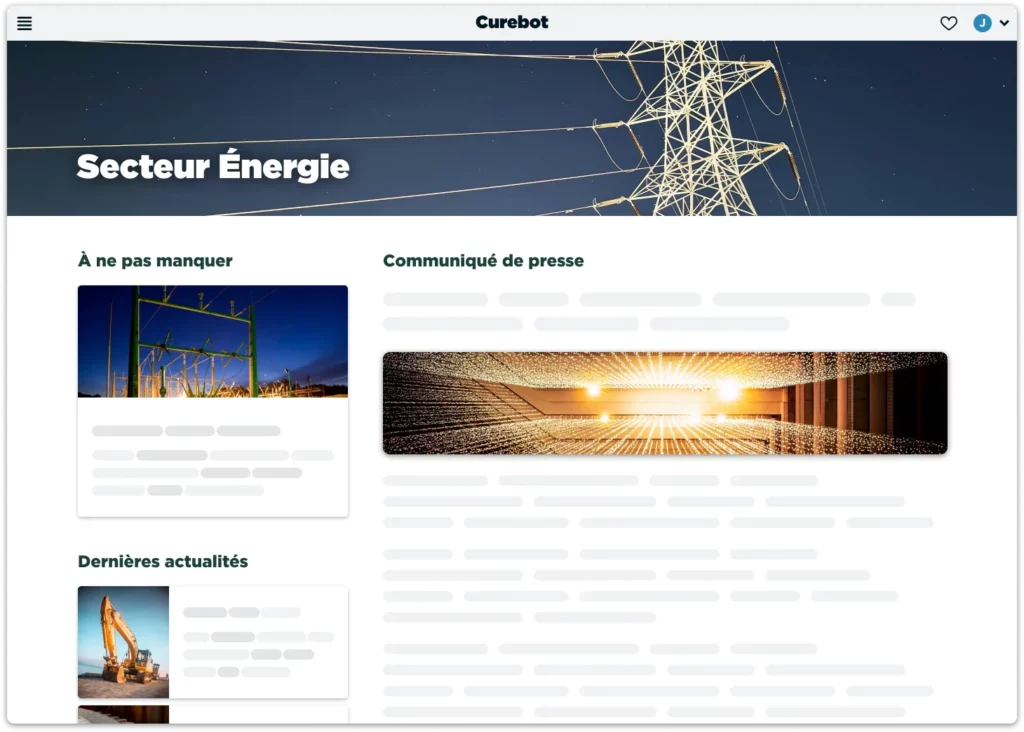
Through his dashboard, a user visualizes his monitoring and that of his team. He launches a query via the search engine; He was interested in an additional watch, and he subscribed to it.
A directory lists the tags, now about a hundred. They are coherent and logical. For example, in RTE’s Paris region, the tag “JO2024” is used.
Other small steps are on the horizon with the addition of new vigils and new collectives. For example, it is the customer and service department that enters the system to monitor customers. The project now has two hundred users.
Cross-trade monitoring community
Based on these initial achievements, Céline Gombert realized that further performance improvements could be made in information management. The topics covered were complex, and the required expertise highly specialized. “We struggle to connect around information and share it,” she observed. She brought this to the attention of senior management. These discussions led to the decision to create cross-functional intelligence communities. It fell to her to drive this initiative. These communities cannot be described as intelligence units; they are comprised of subject matter experts, as it is part of their job responsibilities.
To foster these advancements, Céline Gombert positions herself as a facilitator. She proposes solutions, assists with implementation, and seeks out where value creation is possible. One day, she approaches an executive committee to present her arguments; another, she meets with employees in their teams and demonstrates Curebot. Her approach is paying off, and she begins to receive spontaneous requests. Internal communication efforts are then implemented to reinforce this.
Crisis monitoring also provides a boost. Such an initiative was launched during the Covid-19 crisis, on an ad hoc basis in 2020, monitoring government decisions, the economic situation, and health issues. This operation was relaunched in 2022 in response to the Russian offensive in Ukraine. “This raises awareness of the monitoring process,” comments Céline Gombert.
Parallèlement, tous les un à deux mois, Céline Gombert, Jérémy et un alternant réalisent une analyse faisant ressortir les tendances informationnelles du moment. Cette analyse est intégrée dans Curebot pour être partagée et capitalisée.
What about the deliverables from the monitoring? “To get the collective off the ground, we systematically generated newsletters,” recalls Céline Gombert (by tagging information with an “action,” its publication in a newsletter is triggered). This also allowed us to reach an audience outside the monitoring platform. The topics of these newsletters included: the energy transition, the decarbonization of industry, etc.
Towards a shared work environment?
Finally, this platform could gradually move towards a shared work environment. Not to try to get the most out of the tool, but because the logic of information sharing and therefore the users demand it.
Céline Gombert is aware that she is “clearing” the ground. But it remains supported by Esprits Collaboratives and moves forward with a group of users. When small steps lead to big leaps forward.